Bondi got flipped!

1 11 2009

Now, I have missed the dust storm but this is too much to miss. Bondi got “flipped”…

Aparrently, this is a new surfing phenomenon which was started today and is called “Towel Surfing” !?!?!? According to the poster of the video below over 200 people joined in synchronous dance on their towels in a perfectly choreographed routine that amazed onlookers. Have a look:

Now that looks very much like the T-Mobile video where a number of dancers stunned people in Waterloo station in the middle of the day when the speakers that normally tell train times started playing music:

So do you know what that this Bondi thing was all about?


Are you aware of the new business models which are now available on the web?

1 11 2009

After a stimulating discussion with some work colleagues last night, I was once again reminded that there is always much more happening on the web than one can keep up with.

While the media focus on teenagers spending a large amount of unproductive time on Facebook and celebrities positing uninteresting twitter updates, there are a lot of new business models and breaking of old paradigms on service delivery happening.

One great example is the number of marketplaces which are staring to blossom. They function in a very similar way to eBay, where independent sellers can offer their products and are evaluated by the buyer community. If you are a reputable seller then it should not be risky to buy from you.

Let’s take a look at rentacoder.com for instance. If you need a programmer to develop software to a specific need, you can go to the website and post your program or problem. Some of the 250k coders from around the world which subscribe to the website will send you their bids for delivering the work. You can review the bids and each bidder’s resume and reputation online. When you’re ready to make your decision, you can hire your personal, expert, coder with just a few clicks!

Posting a bid request is free, and you would not be under obligation to accept any bids.  Once the bid is accepted, there is a requirement to put the payment into escrow which will be released to the coder once the work is completed according to the original specification. If there are any problems (apparently there are not many according to the website forum) an outside party to arbitrate is available.

Marketplaces like this are supported with an infrastructure which includes technology, communication, framework for evaluation of reputation and comparison and payments and which is quite efficient and has been proven over the about 5-10 years in which the concept has been maturing. As far as payments are concerned, PayPal is a very interesting example: it started as an alternative to old EDI transactions offered by banks and now is a “de facto” way of transferring money on the web. Another commonly used alternative are, of course, credit cards. There are several statements of misuse and fraud using credit cards, not to mention exchange rates and fees, but there is an efficient model for treating disputes established by the bank and a strong campaign to maintain the trust ensures that consumers continue to use credit cards on a continued basis for internet payments.

I have met a gentleman last night who runs a global publishing company and have made significant money selling his books online on the top of his day job. How did he do it? Here are some of the interesting initiatives:

-          Established virtual presence (i.e. an registered company with address, phone, fax but without any employees or offices) on the US, UK, Singapore and Australia. A way you could do this is using skype-in to have local numbers in over 25 countries. With MyUS you can have an address in the states and they will forward your mail to wherever you want in the world. eOffice allows you to do the same and hire an office or  have virtual working rooms in the UK.

-          You can hire people or programmers to develop a webpage and an ordering system through marketplaces such as rentacoder.com or DesignFirms.

-          If you have a publishing business for example, you can distribute a pdf book through the web and get it printed and delivered on demand. Lulu is a website based on the UK which offers exactly that for a fee.

These are just examples of how you could set up a proper businesses using these new online tools available. There are much more different and interesting stuff out there (let me know on the comments section if you have suggestions!).

More than ever: if you have an idea or a product that everyone wants there’s never been a better time to put it out there.


Hello Merlion!

19 10 2009

Hi All,

As some of you might know I have been living in Singapore and will stay here for the next 5 months. It is a very exciting professional opportunity with an Accenture client and which will also allow me to experience South East Asia and enjoy all the interesting things the region has to offer.

I still live in Sydney though, and will be home at least once a month to put the affairs in order and see my good friends.

For now, I wanted to share with you a bit of the country which I am living at the moment:

Flag of the City-State of Singapore

Flag of the City-State of Singapore

The Republic of Singapore is city-microstate located in the south of the Malay Peninsula. It is an island approximately 10 Km2 positioned very close to the equator, consequentially having a very hot and humid climate.

Singapore used to be a British colony and the hub of the British empire in South East Asia. The region was occupied by the Japanese during WWII and returned to the British when the war was over. The state became independent in 1963 and a republic in 1965, joining the Commonwealth and the UN straight after that.

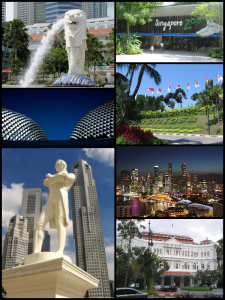
Interesting things to see in SIngapore. Source: Wikipedia

Interesting things to see in SIngapore. Source: Wikipedia

Since independence, Singapore’s has progressed to be one of South East Asia’s most impressive cities. The country has a very modern economy based on strong trade, education and urban planning. A strong centralised government provides the stability so foreign investment is abundant and assists driving growth. Many global organisations operating in South East Asia have their headquarters in Singapore, taking advantage of fiscal benefits, great infrastructure (Singapore ‘s port is one of the busiests in the world) and skilled English speaking manpower.

The population of Singapore close to 5 million people. The city is extremely diverse with Chinese people forming an ethnic majority and large populations of Malay and Indian. English, Malay, Indian, and Chinese are the official languages.

I will let you know more as I discover more!


Movember video!

26 11 2008

Do I need to write anything?

Oh yes.. please donate! Do do it now click here.


Do you also hate telemarketers?

18 11 2008

I don’t think we have this type of problem in Australia, specially with the Spam Act, but in the US the issue with unsolicited calls seems to be pretty bad.

While uploading some videos to Youtube I came across to this video, showing how one guy got back at them.

Enjoy!


Fraud Numbers in Australia. Are we secure?

12 11 2008

“UPDATE: Arno Brok, who works with met at Accenture, has just sent me this interesting article about a new credit card that is being developed and tested in Australia.

Thanks Arno!”

The Australian Bureau of Statistics published in June this year its Personal Fraud Survey, which was conducted between July and December 2007.


There are some very interesting numbers:


- A$ 615 million were lost due to credit card fraud in Australia last year;

- The median, or most common loss was A$ 450 per person, but the mean loss was over A$ 2,000 per person, and 3 percent of victims lost over A$ 10,000.

- 75.5% of people targeted reported the loss; and

- 57,800 of 383,300 people were defrauded by phishing scams.


It is the first time I have seen this type of information shared with the public. Banks around the world do not generally make their internal statistics on fraud public. One of the reasons is the potential loss of confidence from customers and the market.


It is simple like that: Banks and other businesses make multi million dollar savings by automating services to customers. Those savings come, for example, from less staff and less branches/tellers. Also, many consumer retailers have moved into the online selling world, where you can save a significant amount by minimising stock and costs related to brick and mortar stores.


For all to work, consumers need to be confident in using the system. A consumer will not send his/her credit card information online if he/she knows that it is going to be stolen and subject to fraud. Andrew Wallis, a Gartner Analyst, said the following on the Sydney Morning Herald edition of 7 October 2008:


“It’s a classic thing. How do you get people moving into something? Well, you don’t tell them it’s dangerous. You don’t mention the negative side. You’ll extol the virtues and benefits”.


And that’s what banks have been doing. There is now a sense that online transactions are secure!


I beg to differ… if 5% of the Australian population aged 15 years and over suffered some type of fraud over the last 12 months then I would say that it is not that secure. However, we do have to look at it from a risk point of view.


From the banks perspective: if they spend A$ 615million, would they bring the amount of fraud to zero in Australia? Is it sensible to assume that A$ 615million is the acceptable risk banks are willing to take and pay customers back (as they do) so they keep the confidence in the system?

I’m not saying that banks should not invest in controls to address frauds. As a matter of fact I think it is the right thing to do. One example is the ANZ Falcon, which does not only mitigate the risk of losses due to fraud but is a marketing tool for ANZ credit card services. However, there is a limit to which you can mitigate the risk – there will always be a residual risk.


From the customer perspective: all we are worried about is not losing money, so as long as the banks are paying for the fraud we should be happy.


Banks might not pay customers in some isolated cases of misuse, however I believe that they will keep paying off most frauds as a cost of business, due to the fact that the savings of automating transactions and increased credit card usage will cover most of these expenses.


Banks will also keep investing on implementing fraud countermeasures, but the residual risk will always exist and, as long as the banks are paying for it, consumers shouldn’t be worried.


SaaS (Software as Service) Risks

7 11 2008

There’s been a lot of discussion recently around Software as a Service, or SaaS. Although some may say it is new concept, SaaS has been around for some time – since 2000, I believe – and used to be referred as ASP, or Application Service Provider. The idea seems to be working well: IDC recently forecasted that worldwide spending on SaaS will reach $10.7 billion by 2009.joke SaaS

The need for SaaS has evolved from the increasing licensing and maintenance costs of applications, which became prohibitive for some organisations. The cost for upgrades is also avoided, as the business model that SaaS providers operate imply on a periodic (usually monthly) payment instead of traditional application licensing. Further to this, SaaS providers run the software on their own infrastructure (hardware, operating systems, network, etc… ) avoiding other costs with infrastructure, datacenter operation and maintenance. Most SaaS providers also offer 24 x 7 technical support, physical and electronic security, and built-in support for business continuity.

SaaS definition can be simplified as nothing more than a pay-as-you-go outsourcing model where your internal application is hosted, managed, maintained and operated by a service provider across the Internet.

Of course, such arrangement has its challenges. customers relinquish control over software versions or changing requirements; moreover, costs to use the service become a continuous expense, rather than a single expense at time of purchase.

SaaS also has the same fundamental risks as outsourcing, as the client data is stored and processed by a third party. There are some interesting articles and checklists available on the subject. Some of them include:

- Gartner “Critical Security Questions to Ask a SaaS Provider”
- Financial Industry Shared Assessment Program (Third party review questionnaire developed in the US to assess third service provider security in line with ISO 27002)

I have also written an article to SANS about outsourcing which might be helpful. You can find it here.

The key thing for organisations considering SaaS is to perform appropriate due diligence over the provider. This means that, in order to mitigate inherent security outsourcing risks, it needs to get assurance over the ability of the SaaS provider to support business requirements and the controls that exist on the environment.

There are auditing standards that can help, such as SAS70, which brings some assurance and comfort over a third party service provider controls. However these are just a start when an organisation is considering SaaS and not sufficient to ensure that business requirements will be consistently addressed.

For a comprehensive assessment, an organisation should consider a decent baseline. A good start is CobiT and APRA. Also, consulting companies such as <selling hat> Accenture</selling hat> have frameworks to perform such assessments for a fee. :-)

Hope you find the post useful. I am still reading about the topic, so would appreciate your comments with your views on SaaS and experiences with providers.


Clean shaved photo

3 11 2008

Dear all,

Second day on Movember and my mo is growing slowly. As promised, below a clean shaved photo from this Saturday, 1 November:

The Movember website wasn’t accepting donations for a while, but it is back online. If you can donate, please do at this address.

Thank you for your support!

All the best,

Daniel


Movember is back!

28 10 2008

I am not sure you have heard about Movember, which is an annual charity event held during November to raise money to benefit men’s health – specifically prostate cancer and male depression.

At the start of the month guys register with a clean shaven face. The Movember participants, known as Mo Bros, have the remainder of the month to grow and groom their Mo. Mo Sistas (ladies who support their guys or just love Mo’s!) also help Mo Bros and helping to raise funds.

So, during Movember (the month formerly known as November), I’m growing a Mo. That’s right… I’m going to look ridiculous but I believe it is for a good cause.

Men lack awareness about the very real health issues we face. There is an attitude that we have to be tough – “a real man” – and are reluctant to see a doctor about an illness or go for regular medical checks. Movember aims to change these attitudes and make men’s health fun by putting the Mo back on the face of fashion and in the process raise some serious funds for key men’s health issues, including:

- Prostate Cancer: because every year 2,900 Australian men die from prostate cancer and over 18,000 men will be diagnosed with prostate cancer.
- Depression in Men: because one in six men experience depression at any given time but most don’t seek help.

To donate to my Mo you can either:

1.    Click this link and donate online using your credit card or PayPal account, or
2.    Write a cheque payable to ‘Movember Foundation’, referencing my Registration Number 1421956 and mailing it to:

Movember Foundation
PO Box 292
Prahran VIC 3181

Remember, all donations over $2 are tax deductible.

The money raised by Movember is used to raise awareness of men’s health issues and donated to the Prostate Cancer Foundation of Australia and beyondblue – the national depression initiative. The PCFA and beyondblue will use the funds to fund research and increase support networks for those men who suffer from prostate cancer and depression.
Hope you can contribute!


The Coolooli

20 10 2008

This weekend I have joined some friends to dive the Coolooli. The shipwreck is a bucket dredge that was sunk in 1980 as an artificial reef and now lays at 48msw.

Trip from the Coolooli to Rose Bay Wharf plotted on a map

Trip from the Coolooli to Rose Bay Wharf plotted on a map

The wreck location is roughly in front of dee-why beach, in the northern suburbs of Sydney. It is a great spot for technical divers to train and have a great start of the day.

I usually dive on the Scubaroo, the boat owned and manned by our French friend Yves, one of the funniest skippers in Sydney. The ride to the site takes about 45 minutes, as it is approximately 8 miles away from the pickup point at Rose Bay Wharf. The boat normally leaves at 6:45 in the morning, so I usually have to mind the drinks on Friday night.

The trip to the site is stunning, with the sun rising on the horizon and the sight of the heads while going outside of the Sydney Harbour.

The dive is always good, even when it is murky at the surface. The bottom rarely has less than 8 meters visibility (I have dived there at least 5 times and never got less than that) with average 15 meters. As the wreck has been cleaned before sinking there are heaps of space for penetration. You can easily get in at the bottom and make your way through the wreck to exit close to the line at the shallowest point around 36 meters.

Due to the depths, I dive and recommend divers to use Trimix. Also, as decompression is required, proper tech diving training is strongly recommended. Further to this, the use of a dry suit is a good idea as the dive run time can be as much as one hour on 16oC water during the summer (it was 14oC at the bottom yesterday)

You can find more information about the Coolooli on the Michael McFayden website, which is a great source of general information about Sydney diving.

Also, I have embedded below a video from Andrew Cronan that was shot with the DiveFrontier crew. These guys are a group of GUE certified divers in Sydney who are involved in a number of interesting diving projects. But this is a topic for a future post… :-)